
How Beachwood Canyon Became “Hollywoodland” — The Real Story Behind L.A.’s Most Famous Hillside
If you stand under the stone gate towers on Beachwood Drive and look uphill, you’re staring at the front door of a 1920s real-estate experiment that sold Los Angeles a new kind of city life. The neighborhood it advertised was called Hollywoodland, and the billboard for the sales pitch is the hilltop sign we all know today. Much of that early plan is still visible on the ground, from the original sales office at 2700 N Beachwood Dr to the stairways chiseling up the canyon walls.
From ranch land to a planned hillside village
In 1923, a syndicate led by developers S. H. Woodruff and Tracy E. Shoults, with backing and publicity from Los Angeles Times publisher Harry Chandler and railway magnates including Moses H. Sherman, opened Hollywoodland at the northern end of Beachwood Canyon. They pitched it as a master-planned retreat within the city, with curving streets that followed the terrain, storybook architecture by designers like John DeLario, and granite walls, gates, and stairways built by European stonemasons.
The most literal gateway to that plan still stands on Beachwood Drive near Westshire and Belden. The twin stone pylons known as the Hollywoodland Stone Gates have been protected as a City of Los Angeles Historic-Cultural Monument since 1963 (Monument No. 20). Step a few yards north and you’ll find the original sales office at 2700 N Beachwood Dr, built the same year the tract opened and still operating as Hollywoodland Realty today.
Beachwood’s public stairways are a quieter clue. The six interconnecting granite staircases and the neighborhood’s retaining walls were collectively landmarked by the city in the early 1990s (HCM listing for Hollywoodland’s Historic Granite Retaining Walls and Stairs). They weren’t whimsical decorations. They were practical infrastructure meant to knit together hillside lanes without requiring long detours by car.
For a quick, tangible “then-and-now,” walk the short block between the stone gates and the current café-and-market cluster. Beachwood Café at 2695 N Beachwood Dr serves daily from 8 am and stays open until 9 pm Friday and Sunday (breakfast and lunch daily, dinner Friday–Sunday). Those hours make it one of the few places where you can sit with a coffee and literally face the original gateway that sold Hollywoodland a century ago.
The sign began as an ad, not a monument
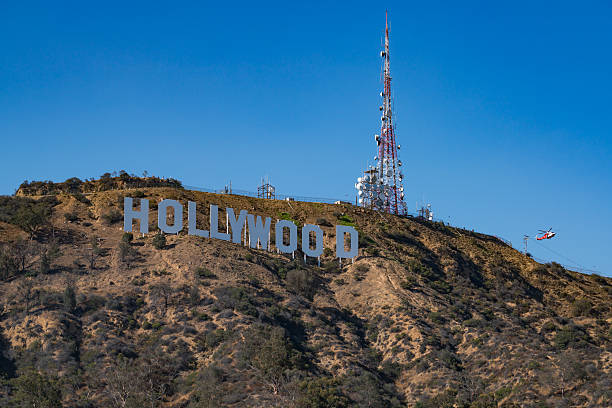
The hillside sign first went up in late 1923 as a piece of sales hardware for the Beachwood Canyon development. It didn’t say “Hollywood.” It said Hollywoodland, and it blinked in segments — “HOLLY,” then “WOOD,” then “LAND” — using roughly 4,000 bulbs. The letters on that temporary installation were about 50 feet tall. The point wasn’t civic pride. It was to sell lots.
After the Depression and World War II, the sign was in rough shape. In 1949, a repair agreement between the City of Los Angeles and the Hollywood Chamber of Commerce dropped the “LAND,” reframing it as a marker for the broader district instead of a single subdivision. Three decades of weather later, the city and donors replaced the crumbling wood-and-sheet-metal structure with steel letters in 1978. The rebuilt sign’s letters measure roughly 44–45 feet high, anchored by concrete footings, and the alignment remains on Mount Lee above Beachwood Canyon.
One habit that never changed is the security perimeter. The slope around the letters is fenced and alarmed, and there is no legal route to stand beneath, touch, or climb the sign. If a guide or stranger promises otherwise, they’re selling a myth and a trespass citation.
Walking the original footprint today
The gates, the plaza, and the sales office
Start at the stone gates on Beachwood Drive and walk north a minute to the small commercial node. The sales office at 2700 N Beachwood Dr anchors the block. Across the street, Beachwood Café keeps neighborhood-friendly hours — 8 am–4 pm Monday–Thursday and 8 am–9 pm Friday and Sunday — and serves dinner Friday–Sunday 4–9 pm. Between the café, the market behind it on Belden, and the gates in your line of sight, it’s one of the few places in Los Angeles where a 1920s sales pitch is still a living streetscape.
Lake Hollywood Park and the reservoir loop
For a classic postcard view of the modern “Hollywood” sign that still sits above the original Hollywoodland, head to Lake Hollywood Park, 3160 Canyon Lake Dr. The park is day-use only, open roughly sunrise to sunset, and the view back to Mount Lee is unblocked by foreground buildings. Street parking lines Canyon Lake Drive, but it is heavily signed and patrolled; read curb signs carefully before you lock and leave.
If you want a longer walk that traces part of Hollywoodland’s northern edge, circle the reservoir. The Lake Hollywood Reservoir loop is about 3.5 miles on a paved path over and around Mulholland Dam. Access gates open in the morning and close in the early evening on a seasonal schedule posted on-site by LADWP, so plan a lap that ends before closing. There is no admission fee for the loop.
Bronson Canyon and the “Batcave” quarry
The western boundary of the original Hollywoodland area brushes today’s Bronson Canyon, the old quarry made famous on film and TV as the “Batcave.” The trailhead and parking are at 3200 Canyon Dr, and the area is listed on the city’s park site as open 5:00 am–10:30 pm. It’s a flat quarter-mile to the tunnel opening, and the larger Brush Canyon trail network climbs from the same entrance if you have time for a proper hike.
Access myths vs. what actually works in 2026
Many online directions still steer people to the top of Beachwood Drive to get onto the Hollyridge Trail. That entry was litigated and reconfigured years ago. Since 2017, the Beachwood gate operates as a pedestrian exit only from Griffith Park. You cannot begin a legal hike into the park at that gate. The nearest legal access points from the Beachwood/Los Feliz side are Canyon Drive for the Brush Canyon Trail and the network near the Griffith Observatory, both of which offer posted hours and managed parking.
Parking is the other point where rumor and reality part ways. The upper Beachwood streets sit in a City of Los Angeles preferential parking district, and most blocks require a resident permit at most hours. If you don’t have one, you are a likely ticket. The practical play for sign-and-history seekers on the Beachwood side is to park legally at 3200 Canyon Dr for a hike, or along Canyon Lake Dr by Lake Hollywood Park for a view. Trails in Griffith Park close at sunset, so time your return accordingly.
If you want a guaranteed route onto the hills without hunting for curb space, there’s a paid option that has existed here almost as long as the neighborhood itself: horses. Sunset Ranch Hollywood operates at 3400 N Beachwood Dr and has offered guided rides in Griffith Park since the 1920s. As of this season, the popular Mulholland Trail ride runs about an hour with rates starting at $75 per person; the Mt. Hollywood two-hour ride starts at $145 per person, and the evening two-hour tour is listed at $175 per person. Reservations are required, and the ranch provides free on-site parking for booked riders.
Two ways to read Hollywoodland on foot
Think of Beachwood Canyon’s early infrastructure as a set of lines you can still trace. One line is vertical: the granite stairways that splice up the slope from the gates and the lower village streets to the cul-de-sacs and view homes above. Another line is horizontal: the dam-and-reservoir path, which marks where the development met the city’s water system and the open space that would become the backstop to its rooftops.
Both routes cost nothing and require no special permits. The stairs are a set of short, steep bursts that connect residential lanes. Keep voices down and step aside for residents, because these are living passageways with front doors at either end. The reservoir is a long, level loop. Expect security gates to be locked on schedule and occasional LADWP vehicles on the service road. On a clear morning, both routes read like blueprints for why the developers picked this valley: protected hills to the north, the city’s grid to the south, and easy showmanship from almost any turnout.
Where to stand, what it costs, and how long it takes
| Option | What you get | Typical time | Cost | Parking & hours | Who it suits |
|---|---|---|---|---|---|
| Lake Hollywood Park (3160 Canyon Lake Dr) | Direct sightline to the modern “Hollywood” sign with lawn space for photos | 20–40 minutes | Free | Day-use, roughly sunrise–sunset; street parking on Canyon Lake Dr with posted restrictions | Families, travelers short on time, wheelchair users on nearby sidewalks |
| Brush Canyon Trail from Canyon Dr (3200 Canyon Dr) | Legal hike in Griffith Park with sign viewpoints and access to Bronson Canyon | 1.5–3 hours round trip depending on route | Free | Trail system closes at sunset; parking at the end of Canyon Dr near trailheads | Hikers seeking a workout and a closer, legal look at Mount Lee |
| Sunset Ranch guided ride (3400 N Beachwood Dr) | One- or two-hour horseback tours on Griffith Park trails with sign views | 1–2 hours | $75–$175 per person depending on tour | Reservations required; free ranch parking; ranch lists daily operating hours | Visitors who prefer a guided, timed experience without navigating trail maps |
Quick takeaways for planning
- The Hollywoodland Stone Gates on Beachwood Drive are a protected 1920s landmark and the right place to begin reading the neighborhood’s original plan.
- The sign began as Hollywoodland in 1923 with about 4,000 bulbs; “LAND” was dropped in 1949, and the steel rebuild came in 1978.
- For photos without a hike, use Lake Hollywood Park at 3160 Canyon Lake Dr. It’s day-use only, no fee, with heavily signed curb parking.
- For a legal hike toward sign views, start at 3200 Canyon Dr. Trails close at sunset and parking fills on fair-weather weekends.
- For a timed, guided option with guaranteed access, Sunset Ranch rides start near $75 and include free on-site parking for booked guests.
- If you want to sit with the gates in view, Beachwood Café opens at 8 am daily and serves dinner Friday–Sunday 4–9 pm.
Reader Q&A
Can I still hike into Griffith Park from the top of Beachwood Drive?
No. Since 2017 the Beachwood gate has operated as a pedestrian exit only. To start a legal hike, use the Canyon Drive entrance at 3200 Canyon Dr for Brush Canyon trails or approach from the Griffith Observatory side, both of which have posted hours and managed parking.
Where is the best free spot to see the sign without a long walk?
Lake Hollywood Park at 3160 Canyon Lake Dr offers a clear view toward Mount Lee with space to frame photos. It is day-use only and street parking is signed and enforced, so check the curb before you head to the lawn.
Is there a way to get into the hills without worrying about parking?
Yes. Sunset Ranch Hollywood at 3400 N Beachwood Dr runs one- and two-hour guided rides on Griffith Park trails. Current published rates range from $75 for a one-hour ride to $175 for a two-hour evening tour, and the ranch provides free on-site parking for reserved riders.
How long is the paved walk around the Lake Hollywood Reservoir?
The reservoir loop is about 3.5 miles on a paved path that crosses Mulholland Dam. LADWP opens and closes access gates daily on a seasonal schedule posted on-site, so plan to finish your circuit before the evening closure.
To narrow your choice, pick the experience that matches your time and tolerance for logistics. If you have 30 minutes and a rideshare, go to Lake Hollywood Park; if you want history under your feet, start at the gates and the sales office, then climb a stairway or head for the reservoir; if you would rather book a time and let a guide lead, reserve a Sunset Ranch ride and park at the ranch.
Published: September 9, 2026