
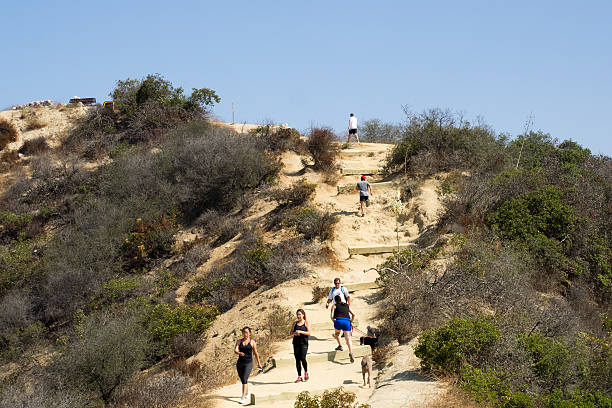
From “No Man’s Canyon” to a City Park: The Real Story Behind Runyon’s Public Land
You have probably heard someone on the trail say “Errol Flynn used to own this place.” He did not. The canyon’s path to public land is messier and more interesting than that balcony-myth suggests. What you walk today is a rare slice of Hollywood Hills privately held for a century, nearly parceled into luxury lots, then pulled into Los Angeles’s park system in the 1980s and managed ever since as a working urban wilderness with rules, hours, and compromises that only make sense in this city.
If you are heading there today, the park’s official address is 2000 N. Fuller Ave., Los Angeles, CA 90046. It is operated by the City’s Department of Recreation and Parks, in Council District 4, and the gates follow one simple rule: they open at sunrise and close at sunset. Admission is free, but there are no restrooms, which is a quirk that traces to how and when the land finally entered the public domain.
From Greek George to the coal magnate: how a private canyon got its name
Before property lines, the Tongva people camped along these ridges. The first recorded title after American statehood appears in 1867, when “Greek George” Caralambo, a veteran of the U.S. Army’s Camel Corps experiment, received the canyon. Through the early 1900s it passed quietly among private owners while Hollywood grew up around it.
The name you see on trail maps arrives in 1919. That year Carman Runyon, an East Coast coal businessman, bought the tract as a riding and hunting retreat. The name stuck. Runyon’s tenure also launched the canyon’s long run as a privately owned playground right over the city’s densest neighborhoods, a tension that would drive every choice that followed.
In the late 1920s famed Irish tenor John McCormack acquired the property from Runyon and built a Mediterranean mansion he called San Patrizio, adding lawns, a reservoir, and tennis courts. He rented the estate to film stars during his frequent tours, which helped set the canyon’s reputation as a secluded enclave with a view. By 1942, McCormack sold to supermarket heir George Huntington Hartford II, who rebranded the estate as The Pines and hired architects from the Wright family to imagine a dramatic resort on the ridge. Neighborhood opposition stopped the hotel and country club; only smaller structures went up. The big project failed, but the idea that this ridge should be monetized never really disappeared.
The failed gift, the fire, and the 1980s deal that made it public
An under-told chapter begins in the 1960s. Hartford tried to donate the property to the City in 1963, aiming to secure its future as open space on his terms. City leadership declined. Hartford sold to a private developer who promptly cleared the old estate buildings in 1970. A canyon-wide fire in 1972 erased much of what was left, and for a decade the property was a patchwork of dirt roads and rumor, a place people snuck into precisely because it was so close and so empty.
Two things changed the trajectory. First, the City and region began assembling a connected network of foothill open spaces. Second, neighbors and hikers organized to keep this canyon from becoming a luxury subdivision. The tipping point came when the City moved to acquire the land as a park and the Santa Monica Mountains Conservancy supplied funding support. In 1984 the City completed the purchase and designated the tract as a municipal park. That single act is why today’s hours, rules, and trail maintenance look and feel like Los Angeles rather than a gated community’s private path.
Because the park was created from a former estate rather than platted as a purpose-built facility, it opened with almost no infrastructure. The City kept the model minimal: a fire road functioning as the main spine, ad hoc footpaths shaped into signed loop trails, gates and fencing to define hours, and a management plan that prioritized access over amenities. You still see those choices in the present-day rules: sunrise to sunset hours, no restrooms on site, and leash policies crafted to balance dog culture with wildlife and neighbor concerns.
What “public land” means here: hours, dogs, and the Hollywood version of stewardship
Runyon Canyon’s operating reality is straightforward and, in Los Angeles terms, strict. Gates open at sunrise and close at sunset daily. Rangers lock the entrances at closing, and nighttime access is not part of the deal. The City posts “NO SMOKING” across the park, a rule that is enforced because hillside fires do not care about intent. The absence of restrooms is not an oversight; it reflects both the canyon’s terrain and the park’s light-footprint origin.
Dogs are welcome under a compromise unique in the hillside system. A designated off-leash area of about 90 acres sits in the interior canyon. The City’s municipal code even maps it with surveyor-like precision, describing an off-leash zone roughly 825 feet north of the Fuller gate, 450 feet east of the Vista gate, and 1,850 feet south of the Mulholland gate. Outside that interior, leashes are required. There is also a fenced, about 21,000 square foot dog-free field between the south entrances. These fine-grained boundaries are not trivia; they are how a heavily used, very small park stays open to both dog owners and people who prefer a pet-free space.
Getting there presents one more Los Angeles-shaped wrinkle. At the south end, the Fuller Avenue and Vista Street entrances rely on neighborhood street parking with posted restrictions that vary by block, including street-cleaning hours. Read the signs and plan a few extra minutes to park and walk in. At the north end, by Mulholland Drive, a small-capacity parking lot serves the top gate. It has limited space and is not a guaranteed spot on busy mornings, but its presence gives mobility-limited visitors a way to experience views from the ridge without a long climb from the flats.
The other mark of public-land status is how the City maintains safety-critical infrastructure. In 2016, the park closed almost entirely for a four-month water-line replacement that crossed the canyon’s length. The closure ran from April 1 through July 31, 2016, with only the south “yoga field” remaining open. It was a disruptive decision made for a public utility project and executed on public ground, and it underscores who ultimately sets the rules here.
Entrances and how locals actually use them
Most people experience Runyon through three main gates, each leading to the same network in a slightly different way. Hours are identical across the park. The differences are practical: how you approach, where you park, and what you meet first underfoot.
| Entrance | How to find it | Parking | Hours | Dog rules at gate | Notable constraints |
| Fuller Avenue (South) | Main gate at 2000 N. Fuller Ave. in Hollywood, north of Franklin | Street parking only; posted limits vary by block | Sunrise–sunset | Leashes required until you reach the interior off‑leash zone | No restrooms; gates locked at sunset |
| Vista Street (South) | Gate at the north end of Vista St. where it meets Runyon Canyon Rd. | Street parking only; mind street‑cleaning signs | Sunrise–sunset | Leashes required until the interior zone | Fenced dog‑free field lies between the two south gates |
| Mulholland Drive (North) | Top gate off Mulholland Dr., signed Runyon Canyon Rd. | Small lot with limited capacity at the north gate | Sunrise–sunset | Leashes required until you descend into the designated zone | No restrooms; expect the lot to reach capacity on fair‑weather mornings |
Locals often choose an entrance based on schedule and company. Walking a dog before work from the flats, Fuller or Vista minimizes drive time and heads straight for the off-leash core. Hosting an out‑of‑town guest who wants the postcard panorama without a steep ascent, Mulholland delivers ridge views immediately after the gate. All three, by design, feed a simple set of loops that keep traffic moving clockwise and counterclockwise without forced bottlenecks.
How to see the canyon’s private past in today’s public loop
Even after forty years as a city park, the canyon still shows its estate era if you know what to look for. Near the south approach, the broad graded way is not a road to nowhere; it is a former estate drive and later a fire and service road, the backbone that made proposed subdivisions plausible. The tennis court slab and a scatter of stone foundations glimpsed from spur paths are not random ruins; they are what remains of McCormack’s San Patrizio compound and the later foundation-run artist cottages that survived neighborhood politics but not time and fire.
The name “Inspiration Point” on many handout maps hints at a master-planned outlook, and that is true. Internal planning documents sketched overlooks, kiosks, and a ranger station in the mid‑1980s. What was built instead was lighter: railings and signage where risk dictated, fencing and gates to enforce day-use hours, and a staffing model that relies on Rangers roving the hills rather than sitting in a staffed visitor center. The result is that the view is real, the approach is simple, and the canyon still reads as a canyon, not a campus.
One more place where the past bleeds into the present is the dog policy. Hollywood has a long, loud dog culture, and hillsides amplify both joy and conflict. The City’s solution was to fix off‑leash privileges to a mapped interior rather than to a fenced rectangle by a parking lot. That is an unusual choice for a municipal dog facility, but it reflects two truths about this site: the interior bowl can contain most of the cross-traffic, and the park’s mission is a hiking canyon first. The fenced, dog‑free lawn between Fuller and Vista gives families and athletic groups a place to gather without having to thread the off‑leash zone at all.
As public land, Runyon also absorbs the region’s basic services work. The 2016 four‑month closure for a one‑mile water pipeline replacement is the clearest example. A city utility project shut a beloved hiking spot in peak season; the yoga field stayed open, the rest did not. The system held because it was public land; there was no homeowner’s association to negotiate with, only a construction schedule and a reopening date. If you were here that summer, you remember the quiet on Fuller and Vista and the odd feeling of a Hollywood Hills canyon with no foot traffic at all.
Parsing the myths: what is true, what is almost true, and what is just Hollywood
“Errol Flynn owned Runyon.” Almost. Flynn lived in a pool house on the property in the late 1950s as a guest of Huntington Hartford. He was never the titled owner. “The City turned it into a park right away.” Not exactly. Hartford attempted to gift the land in the early 1960s, the City declined, a developer scraped the estate, a fire stripped the slopes, and only in 1984 did the City buy it as a park, supported by the Santa Monica Mountains Conservancy.
“It is one giant off‑leash park.” No. Off‑leash access is confined to an approximately 90‑acre interior, defined in the municipal code by distances from the three gates. You are expected to clip a leash on near every entrance and through the ridge approaches. “There is no parking lot anywhere.” That used to be common wisdom, but the north gate by Mulholland Drive has a small parking lot with limited capacity. The south gates remain a street‑parking affair with the usual urban caveats.
“Why no restrooms?” Because this place was bought as open space and kept that way. The park’s own official guidance still reads like a hillside backcountry post: bring water, expect heat, stay on signed trails, pack out what you bring in. That is the inherited logic of an estate redeemed for public use rather than a facility built from scratch.
For all the lore, the throughline is simple. Runyon Canyon became public land because of a 1980s decision to buy, not build. The City and its regional partners chose to acquire and manage a canyon at the edge of Hollywood rather than let it become another closed hillside street. The proof is in the daily particulars: free entry, sunrise–sunset hours, a mapped off‑leash interior, and the expectation that you will read the parking signs before you lace up your shoes.
Key Things to Know
- The park sits at 2000 N. Fuller Ave., Los Angeles, CA 90046 and is managed by the City’s Department of Recreation and Parks in Council District 4.
- Gates are sunrise to sunset daily. Rangers lock entrances at closing. There is no after‑dark access as part of normal operations.
- Admission is free, and there are no restrooms. Bring water and plan accordingly, especially in hot months.
- Dogs may go off leash only inside the designated interior zone of about 90 acres. Outside that zone, leashes are required.
- Between the south gates is a fenced, dog‑free lawn area of roughly 21,000 square feet for picnics and play without pets.
- Parking at Fuller and Vista is street only with posted restrictions that vary by block; the Mulholland side has a small lot with limited capacity.
- In 2016, a one‑mile water-line replacement closed nearly the entire park from April 1 to July 31, an example of public‑land infrastructure work shaping access.
Reader Q&A
When did Runyon Canyon become a city park?
The City completed the purchase and designated it a municipal park in 1984, after decades of private ownership and aborted development plans. Funding support from the regional Santa Monica Mountains Conservancy helped make the acquisition possible, which is why you can walk there today without an admission gate.
Why is it called Runyon Canyon if Errol Flynn lived there?
The canyon took its modern name from Carman Runyon, who bought it in 1919 as a riding and hunting retreat. Errol Flynn did spend time on the property later, living in a pool house during the Huntington Hartford years, but he was a guest, not the owner. The name reflects the earlier owner.
What are the hours and how much does it cost?
Gates are open from sunrise to sunset every day. Admission is free. There are no on‑site restrooms, so plan ahead and bring water. If you are driving to the south gates, expect to use street parking with posted time limits; the north gate off Mulholland has a small lot with limited capacity.
Can my dog be off leash everywhere in the park?
No. Off‑leash access is limited to an interior zone of about 90 acres defined by the municipal code using distances from the three gates. At the entrances and along ridge approaches, leashes are required. There is also a fenced, dog‑free field between the two south gates if you prefer to avoid pets altogether.
Choosing an entrance is the only real decision most visitors make. If you live in Hollywood flats and want the quickest routine, start at Fuller or Vista and follow the posted leash rules into the off‑leash interior. If you are bringing someone who needs the view without the climb, the top gate off Mulholland puts the ridge at your feet immediately.
Published: September 9, 2026